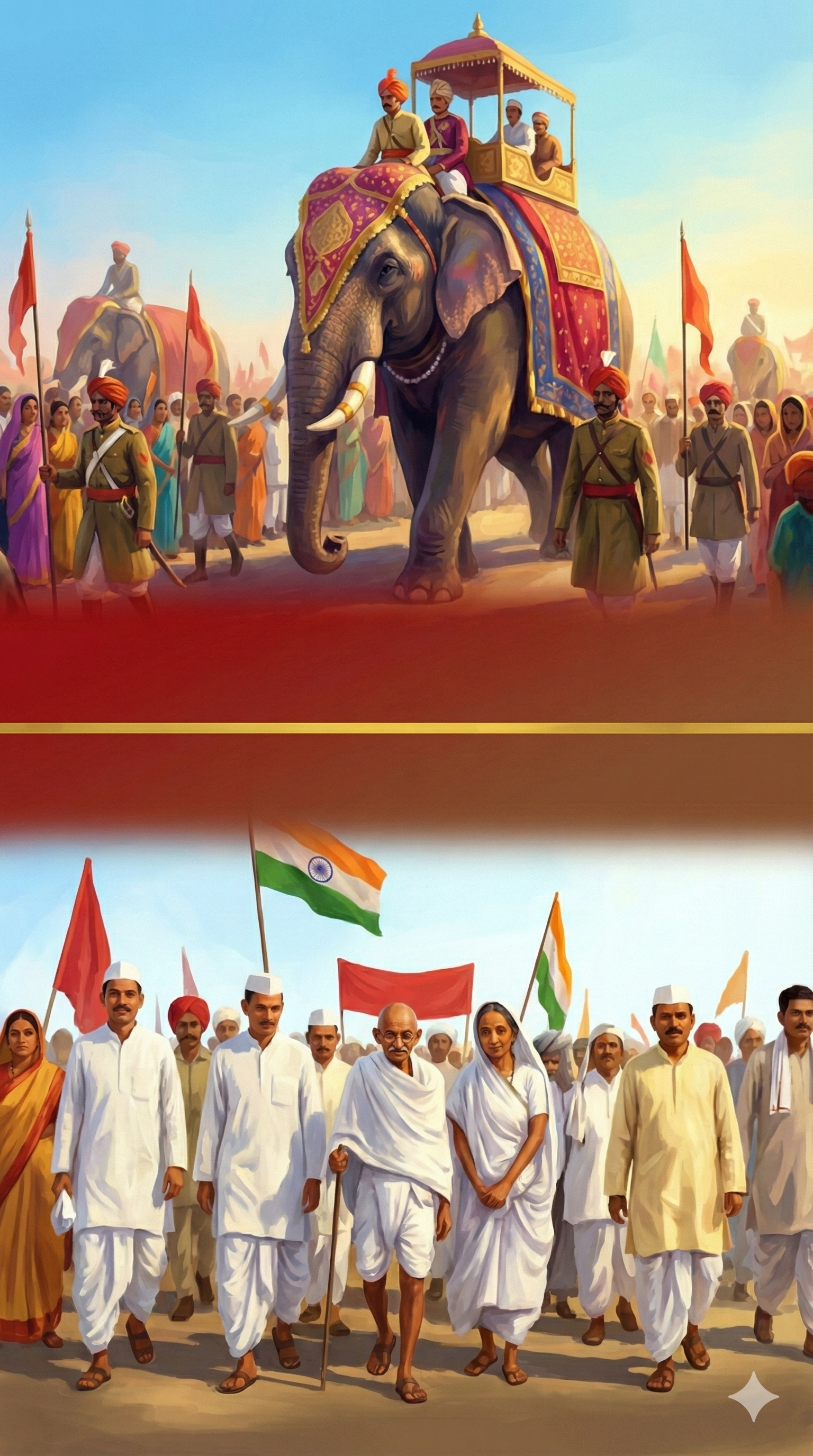
Our Pasts - III (Part 2) - Class 8
HistoryClass 8

Our Pasts - III (Part 2)

Modern Indian history - Part 2

Previous Year Questions

Practice questions from History Our Pasts - III (Part 2)

1

With reference to the Cabinet Mission, which of the following statements is/are correct?

  1. It recommended a federal government.
  2. It enlarged the powers of the Indian courts.
  3. It provided for more Indians in the ICS.

Select the correct answer using the code given below.

A. 1 only(Correct Answer)
B. 2 and 3
C. 1 and 3
D. None

The Cabinet Mission recommended a loose three-tier confederation. India was to remain united. It was to have a weak central government controlling only foreign affairs, defence, and communications with the existing provincial assemblies being grouped into three sections while electing the constituent assembly: Section A for the Hindu majority provinces, and Sections B and C for the existing provincial of the north-west and the north-east (including Assam) respectively.

The sections or groups of provinces would comprise various regional units. They would have the power to set up intermediate-level executives and legislatures of their own.

Source: NCERT: Themes in Indian History Part III

2

The 1929 Session of Indian National Congress is on significance in the history of the Freedom Movement because the

A. attainment of Self-Government was declared as the objective of the Congress.
B. Attainment of Poorna Swaraj was adopted as the goal of the Congress.(Correct Answer)
C. Non-Cooperation Movement was launched.
D. Decision to participate in the Round Table Conference in London was taken.

The 1929 Session of the Indian National Congress holds great significance in the history of the Freedom Movement for several reasons:

  • Demand for Complete Independence: This session marked the first time the Congress formally demanded complete independence from British rule.
  • Resolution of Purna Swaraj: The session passed the Purna Swaraj resolution, which called for full self-governance.
  • Influence of Leaders: Prominent leaders like Jawaharlal Nehru and Gandhi played crucial roles in shaping the agenda.
  • Mobilization of Mass Support: The session helped mobilize mass support for the independence movement across the country.

Overall, the 1929 Session was a pivotal moment that galvanized the Indian populace towards the goal of independence.

Source: Modern India (Old NCERT: 12th Class by Bipin Chandra)

3

With reference to Madanapalle of Andhra Pradesh, which one of the following statements is correct?

A. Pingali Venkayya designed the tricolour Indian National Flag here.
B. Pattabhi Sitaramaiah led the Quit India Movement of Andhra region from here.
C. Rabindranath Tagore translated the National Anthem from Bengali to English here.(Correct Answer)
D. Madame Blavatsky and Colonel Olcott set up headquarters of Theosophical Society first here.

The song Jana-gana-mana, composed originally in Bangla by Rabindranath Tagore, was adopted in its Hindi version by the Constituent Assembly as the National Anthem of India on January 24, 1950. It was first sung on December 27, 1911 at the Calcutta Session of the Indian National Congress. The complete song consists of five stanzas.

It was at Madanapalle (Chittoor), in February 1919, that Tagore translated his Bengali poem 'Jana Gana Mana' into English as 'Morning Song of India'. It was given tune by Margaret Cousins.

Source Citation: NCERT: Class 10 Social and Political Life

4

With reference to Mughal India, what is/are the difference/differences between Jagirdar and Zamindar?

  1. Jagirdars were holders or land assignments in lieu of judicial and police duties, whereas Zamindars were holders of revenue rights without obligation to perform any duty other than revenue collection.
  2. Land assignments to Jagirdars were hereditary and revenue rights or Zamindars were not hereditary.

Select the correct answer using the code given below.

A. 1 only
B. 2 only
C. Both 1 and 2
D. Neither 1 nor 2(Correct Answer)

The Sultan was the fountain pen of the judiciary system in the Mughal period. He was all in all in the state. He was responsible for any kind of error in the state. The second agency of the judiciary was the Qazi. Qazi had a bigger role in the judiciary system in the state and he held the court and gave justice. Whereas Jagirdars were those mansabdars who were given salary in lieu of military service in terms of jagirs (land). Hence statement 1 is not correct. The judicial and police functions were performed locally by zamindars.

An important feature of the jagir system was the shifting of jagir-holders from one jagir to another for administrative reasons. This system of transfers checked the jagirdars from developing local roots. Thus jagirs were transferable and could be seized too. Zamindars on the other hand were hereditary. The zamindars were present in practically every part of the Mughal Empire and held the most significant position in the agrarian structure of Mughal India. Hence statement 2 is not correct.

Source Attribution: Themes In Indian History Part-II; Old NCERT: Satish Chandra, Medieval India

5

Who of the following founded a new city on the south bank of a tributary to river Krishna and undertook to rule his new kingdom as the agent of a deity to whom all the land south of the river Krishna was supposed to belong?

A. Amoghavarsha I
B. Ballala II
C. Harihara I(Correct Answer)
D. Prataparudra II

Vijayanagara or city of victory was the name of both a city and an empire. The empire was founded in the fourteenth century. In its heyday, it stretched from the river Krishna in the north to the extreme south of the peninsula, in the Krishna-Tungabhadra doab. It was founded by Harihara and Bukka, in 1336. In the memories of people living in the Krishna-Tungabhadra doab, they remembered it as Hampi, a name derived from that of the local mother goddess, Pampadevi.

Source: NCERT: Themes in Indian History Part II

Previous Year Questions

Test your knowledge with these practice questions

Question 1 of 50 / 5 answered
1

With reference to the Cabinet Mission, which of the following statements is/are correct?

  1. It recommended a federal government.
  2. It enlarged the powers of the Indian courts.
  3. It provided for more Indians in the ICS.

Select the correct answer using the code given below.

Topic: The Movement of the Working ClassYear: 2015

Don't stop here.

Full PYQ bank • NCERT practice mode • Video lessons • AI-generated notes