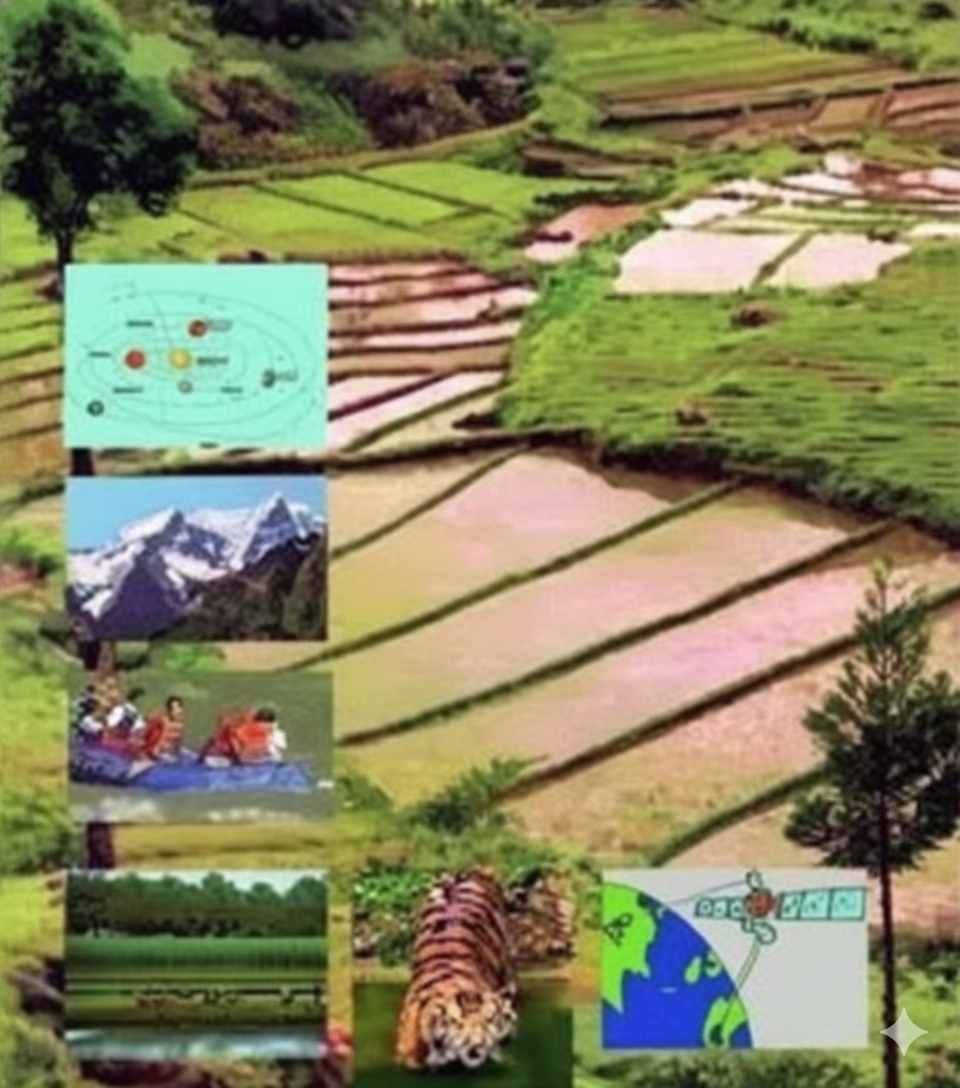
The Earth Our Habitat - Class 6
GeographyClass 6

The Earth Our Habitat

Introduction to geography and Earth

Previous Year Questions

Practice questions from Geography The Earth Our Habitat

1

The seasonal reversal of winds is the typical characteristic of

A. Equatorial climate
B. Mediterranean climate
C. Monsoon climate(Correct Answer)
D. All of the above climates

Explanation:

The seasonal reversal of winds is commonly associated with monsoons. These winds change direction with the seasons, leading to distinct wet and dry periods. The phenomenon is primarily observed in regions such as:

  • South Asia
  • West Africa
  • Australia

During the summer months, warm air rises over land, creating a low-pressure area that draws in moisture-laden winds from the ocean. Conversely, in winter, the land cools, and high-pressure systems dominate, reversing the wind direction.

Source: 11th NCERT: Fundamentals of World Physical Geography

2

Consider the following statements:

Statement-I: The temperature contrast between continents and oceans is greater during summer than in winter.

Statement-II: The specific heat of water is more than that of land surface.

Which one of the following is correct in respect of the above statements?

A. Both Statement-I and Statement-II are correct and Statement- II is the correct explanation for Statement-I(Correct Answer)
B. Both Statement-I and Statement-II are correct and Statement- II is not the correct explanation for Statement-I
C. Statement-I is correct but Statement- II is incorrect
D. Statement-I is incorrect but Statement-II is correct

The specific heat capacity is the amount of heat needed to raise the temperature of one gram of the substance by 1 degree. The specific heat capacity of water is much greater than that of the land because the relative density of water is much lower than that of the land surface. It means more heat is required to raise the temperature of one gram of water by 1 degree than one gram of land.

Physical characteristics of heat transport and ocean circulation impact the Earth's climate system. Like a massive 'flywheel' that stabilizes the speed of an engine, the vast amounts of heat in the oceans stabilize the temperature of Earth. The heat capacity of the ocean is much greater than that of the atmosphere or the land.

As a result, the ocean slowly warms in the summer, keeping air cool, and it slowly cools in winter, keeping the air warm. The temperature contrast between continents and oceans is greater during summer than in winter.

Therefore, both Statement-I and Statement-II are correct and Statement-II is the correct explanation for Statement-I. Hence option (a) is the correct answer.

Source: NCERT: Class XI Fundamentals of Physical Geography, Chapter 9

3

The most important strategy for the conservation of biodiversity together with traditional human life is the establishment of

A. biosphere(Correct Answer)
B. reserves
C. national parks
D. Wildlife sanctuaries

Conservation of biodiversity is crucial for maintaining the health of our planet. The following strategies are essential:

  • Protected Areas: Establishing national parks and reserves to safeguard habitats.
  • Sustainable Practices: Implementing practices that do not harm the environment.
  • Community Involvement: Engaging local communities in conservation efforts.
  • Research and Monitoring: Conducting studies to understand biodiversity and its changes.

These strategies not only help in preserving biodiversity but also support traditional human life by ensuring that natural resources are available for future generations.

Source: 12th NCERT: Unit 10 Chapter 15

4

Consider the following pairs:

HillsRegion
Cardamom HillsCoromandel Coast
Kaimur HillsKonkan Coast
Maadeo HillsCentral India
Mikir HillsNorth-East India

Which of the above pairs are correctly matched?

A. 1 and 2
B. 2 and 3
C. 3 and 4(Correct Answer)
D. 2 and 4

The question asks about the correct matching of hills with their respective regions in India. Let's analyze each pair:

  • Cardamom Hills: These are located in the southern part of India, specifically in the Western Ghats, not on the Coromandel Coast. Therefore, this pair is incorrect.
  • Kaimur Hills: These are part of the Vindhya Range and are located in central India, not on the Konkan Coast. Thus, this pair is incorrect.
  • Maadeo Hills: These hills are indeed located in Central India, making this pair correct.
  • Mikir Hills: These hills are located in the northeastern part of India, which makes this pair correct.

Therefore, the correctly matched pairs are 3 and 4, which corresponds to option (c).

Source: NCERT: XI

5

Consider the following plants:

  1. Groundnut
  2. Horse-gram
  3. Soybean

How many of the above belong to the pea family?

A. Only one
B. Only two
C. All three(Correct Answer)
D. None

The Fabaceae or Leguminosae, commonly known as the legume, pea, or bean family, are a large and agriculturally important family of flowering plants. It includes trees, shrubs, and perennial or annual herbaceous plants, which are easily recognized by their fruit and their compound, stipulate leaves.

Option 1 is correct: The peanut belongs to the botanical family Fabaceae (or Leguminosae), commonly known as the legume, bean, or pea family.

Option 2 is correct: Macrotyloma uniflorum is a legume native to tropical southern Asia, known for its distinct taste and texture, widely used legume in many cuisines. It also belongs to the family Fabaceae.

Option 3 is correct: The soybean, soy bean, or soya bean is a species of legume native to East Asia, widely grown for its edible bean, which has numerous uses. It also belongs to the family Fabaceae.

Source Citation: NCERT

Previous Year Questions

Test your knowledge with these practice questions

Question 1 of 50 / 5 answered
1

The seasonal reversal of winds is the typical characteristic of

Topic: CyclonesYear: 2014

Don't stop here.

Full PYQ bank • NCERT practice mode • Video lessons • AI-generated notes