Importance of NCERTs for UPSC CSE
7 min read
Nov 23, 2025

If you're starting your UPSC Civil Services Examination journey, you'll hear one piece of advice repeatedly: start with NCERTs. Here's why these school textbooks remain the bedrock of civil services preparation.
Why NCERTs Matter
Building the Right Foundation
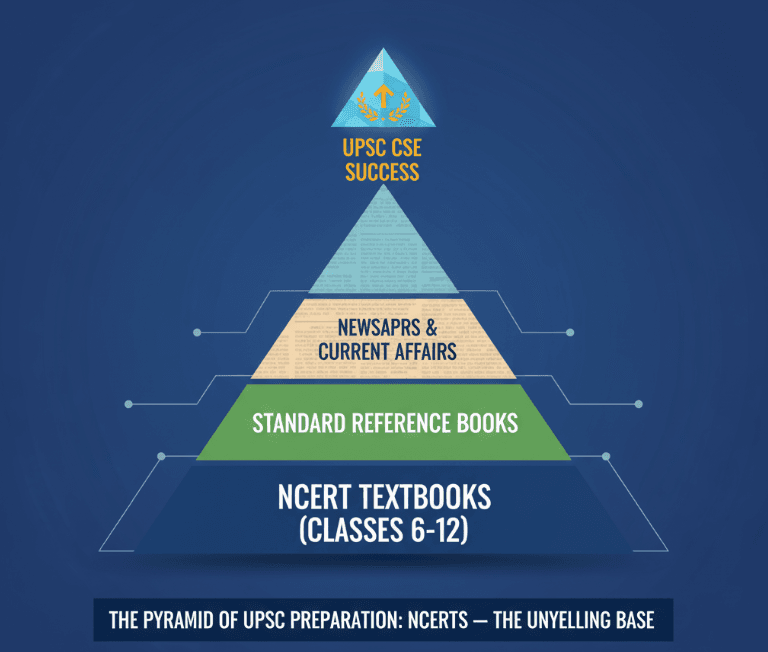
NCERTs serve as your entry point into the vast UPSC syllabus. They help you develop a consistent study habit without the intimidation factor of dense standard books or the daily pressure of newspapers. For someone transitioning from college or a job, this gentle onboarding makes all the difference between starting strong and burning out early.
The Bridge to Advanced Learning
NCERTs create the conceptual scaffolding you need to understand newspapers, standard reference books, previous year questions, and the actual syllabus. Without this foundation, you'll find yourself constantly googling basic terms when reading The Hindu or struggling with references in Laxmikanth or Spectrum.
Example: When you read about the GST Council in a newspaper, you'll struggle to understand its significance without knowing basic concepts like federalism, concurrent list, and fiscal powers—all covered clearly in Class 11 Polity NCERT.
Similarly, understanding farmer protests becomes easier when Class 12 Economics NCERT has already explained MSP, agricultural markets, and rural credit systems.
Mental Frameworks for Synthesis
UPSC doesn't test rote memory—it tests your ability to connect dots across domains. NCERTs help you build broad mental frameworks that enable you to connect and consolidate all the knowledge you gain from various sources. When you read about a policy in the newspaper, your NCERT framework helps you instantly connect it to historical patterns, geographical constraints, economic implications, and social dimensions.
Example: When you encounter a question on "urban flooding," your Class 9 Geography NCERT helps you understand drainage patterns, your Class 11 Geography explains urbanization and land use, and your Class 12 Geography connects it to poor urban planning. This multi-dimensional understanding is what UPSC tests especially in mains, and NCERTs naturally build this integrated thinking.
Direct Value for Both Papers
For Prelims, NCERTs directly yield 15-25 questions annually, especially in History, Polity, Geography, and Science. For Mains, they provide valuable data points, case studies, examples, and diagrams that transform generic answers into substantive ones.
A well-placed example from NCERT Geography on watershed management or a case study from Economics on cooperative movements can be the difference between a mediocre and an excellent Mains answer.
Developing Core Competencies
Beyond content, NCERTs develop your comprehension skills—your ability to extract, understand, and retain information from dense text. This skill transfers directly to how you'll process standard books, government reports, and even question papers during the exam.
Which NCERTs to Read
Not all NCERTs are equally valuable for UPSC. Here's a practical guide:
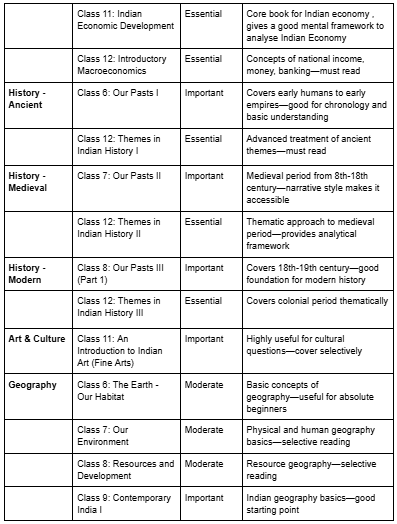
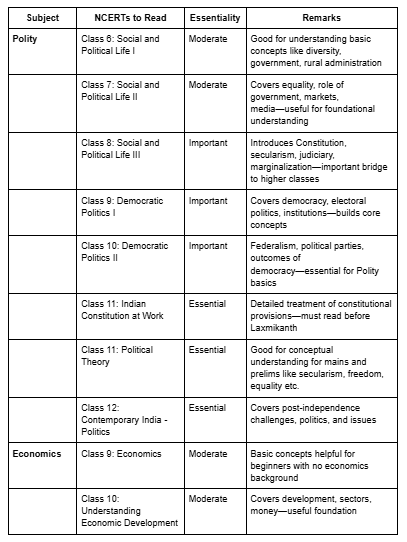
*Note - recently new NCERTs are introduced for class 6th and 7th. While these are also good starting points, it is preferable that you do earlier ones as it contains more information.
When and How to Read NCERTs
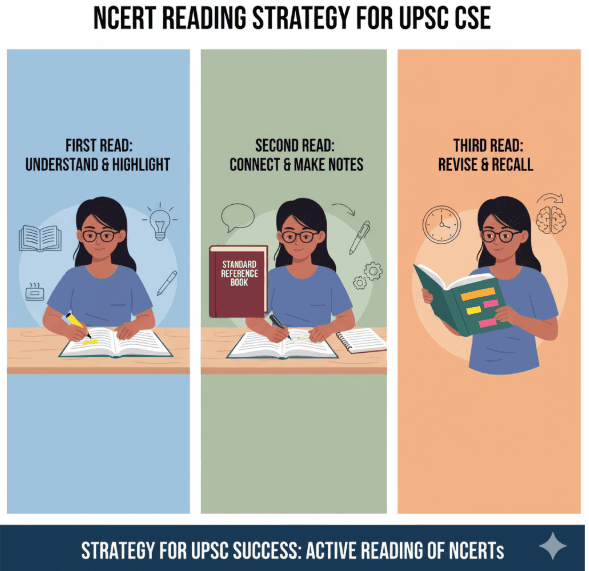
The key to NCERTs isn't just reading them—it's reading them strategically across multiple iterations.
First Read: Understanding and Marking
Your first read is about comprehension, not retention. Read at a comfortable pace, focus on understanding concepts, and underline or highlight key facts, definitions, data points, and examples. Don't take elaborate notes yet. Your goal is to let the information sink in and create mental markers for what's important.
Second Read: Integration with Standard Books
This is where NCERTs truly deliver value. Read NCERTs topic-wise alongside standard books. When you're studying the Indian Freedom Struggle, read the relevant NCERT chapter, then move to Spectrum or Bipan Chandra. Now, integrate the underlined portions from NCERTs into your notes. You'll find that NCERTs often provide clarity, examples, or data that make standard books easier to absorb.
Third Read: Selective Reinforcement
Some NCERTs—particularly History (Classes 11-12), Geography (Classes 11-12), and Polity—benefit from a third reading closer to the exam. This isn't a cover-to-cover read but a quick revision of underlined portions and difficult chapters. By now, these books will feel like old friends, and revision will be rapid.
Post-Reading: Test Your Understanding
After completing each NCERT, solve the exercises at the end of chapters. This is not a trivial step. These questions force you to recall, apply, and articulate what you've learned—the exact skills UPSC tests. Writing answers to these questions is your first training ground for answer writing. If you struggle with an exercise question, you haven't understood the chapter. Go back, reread, and try again.
The Bottom Line
NCERTs are not optional reading, they are the foundation upon which your entire preparation rests. They make difficult books accessible, newspapers comprehensible, and the vast UPSC syllabus manageable. More importantly, they train your mind to think the way UPSC expects: with clarity, structure, and the ability to connect concepts across domains.
To practice NCERT questions in a structured way, download PrepAiro.
FAQs
1. How long does it take to complete all NCERTs?
3-4 months for first-time read (4-5 hours daily). Don't rush—understanding matters more than speed.
2. Should I make notes from NCERTs?
NO in first read. Just highlight. Make notes only in second read when combining with reference books.
3. Can I skip Classes 6-8 and directly start with Classes 11-12?
- Zero background: Start from Classes 6-8
- Comfortable with basics: Start from Classes 9-10
- For Polity & History: Classes 6-8 helpful but not critical
- For Geography: If weak, start Class 6; otherwise Class 9
4. Are NCERTs enough for UPSC preparation?
NO. NCERTs are foundation (30-40% of preparation). You also need reference books + newspapers + current affairs.
5. Should I read NCERTs before or after joining coaching?
BEFORE. Coaching becomes far more useful when you have the basic framework in place.
6. Should I watch video lectures on NCERTs or read them myself?
Read yourself first. Videos can supplement difficult chapters but shouldn't replace self-reading. UPSC rewards active learning.
