New NCERTs 2024: Critical Analysis of Changes & UPSC Implications
6 min read
Dec 04, 2025
The NCERT textbook revisions of 2024-25 have triggered significant debate among educators, historians, and UPSC aspirants alike. With chapters deleted, sections rewritten, and narratives altered across History, Political Science, and Sociology textbooks, one pressing question emerges: How should UPSC aspirants navigate these changes?
This comprehensive analysis breaks down the major content modifications, examines controversial deletions, and provides a strategic framework for handling conflicting information in your civil services preparation.
Understanding the NCERT Rationalisation Exercise
Since 2021, NCERT has undertaken what it calls a "syllabus rationalisation" exercise, initially justified as a measure to reduce student burden post-COVID-19 pandemic. However, the scope of deletions—particularly in humanities subjects—has extended far beyond routine curriculum updates.
The 2024-25 academic session marks the fourth major revision since 2014, with changes spanning Classes 6 through 12. While NCERT maintains these modifications align with pedagogical requirements, critics argue the deletions reflect ideological reorientation rather than educational streamlining.
Major Changes in History Textbooks
Medieval Period: The Mughal Reduction
The most significant alterations affect medieval Indian history. Key deletions include:
- Class 7 (Our Pasts-II): The two-page table detailing achievements of Mughal emperors—Humayun, Akbar, Jahangir, Shah Jahan, and Aurangzeb—has been completely removed
- Class 12 (Themes in Indian History-Part II): The chapter "Kings and Chronicles: The Mughal Courts (c. Sixteenth-Seventeenth Centuries)" was deleted entirely
- Class 7-8: Chapters on Delhi Sultanate substantially reduced or removed
- Class 8: Tipu Sultan removed from Social Science textbooks in the 2024 revision
Modern History: Gandhi and Post-Independence
Changes to modern history sections are equally substantial:
- References to Gandhi's opposition to Hindu extremism deleted from Class 12 Political Science
- Details about Nathuram Godse's ideological affiliations significantly reduced
- The description of Godse as a "Brahmin" and "editor of an extremist Hindu newspaper" removed
- Sentences about the RSS ban following Gandhi's assassination excised
- Class 8: The chapter "India After Independence" removed entirely
UPSC Implication for History
For UPSC aspirants, medieval and modern history remain heavily tested in both Prelims and Mains. The deleted content—particularly Mughal administration, court culture, and post-independence political developments—continues to appear in question papers. Old NCERTs (R.S. Sharma for Ancient India, Bipan Chandra for Modern India) become essential supplementary reading.
Political Science: Rewriting Contemporary India
Ayodhya and Communal History
The 2024-25 Political Science textbooks underwent substantial rewriting:
- Babri Masjid renamed: Now referred to as "three-domed structure" throughout Class 12 textbooks
- The Ayodhya section reduced from four pages to two pages
- References to the demolition, L.K. Advani's Rath Yatra, and RSS karsevaks removed
- Focus shifted to the Supreme Court's 2019 verdict as the primary narrative
- Newspaper cuttings related to the Kalyan Singh government's removal post-demolition deleted
Emergency and Democratic Movements
- References to controversies surrounding the Emergency (1975-77) substantially trimmed
- Class 10: Full chapters removed—"Democracy and Diversity," "Popular Struggles and Movements," and "Challenges to Democracy"
- Discussions on the Naxalite movement and Dalit movements reduced
Kashmir and Foreign Policy
- Abrogation of Article 370 added as new content in Class 12 textbooks
- "Azad Pakistan" changed to "Pakistan Occupied Jammu and Kashmir"
- India-China relations rephrased—"military conflict over border dispute" replaced with "Chinese aggression on Indian border"
- Reference to J&K's accession to India on the promise of autonomy removed
Gujarat Riots: Complete Removal
Perhaps the most contested deletion involves the 2002 Gujarat riots:
- All references removed from Political Science and Sociology textbooks
- The chapter on Democratic Rights no longer mentions the riots
- Sociology textbook's discussion on ghettoisation of religious communities post-riots deleted
Sociology and Social Issues
The Class 11-12 Sociology textbooks also underwent significant revision:
- References to struggles of Scheduled Caste and Scheduled Tribe communities deleted
- Impact of large dam projects on tribal groups removed
- Discussions on social inequalities and caste discrimination reduced
- References to the varna system and practice of untouchability trimmed
Old NCERT vs New NCERT: What UPSC Aspirants Should Know
Content Comparison Matrix
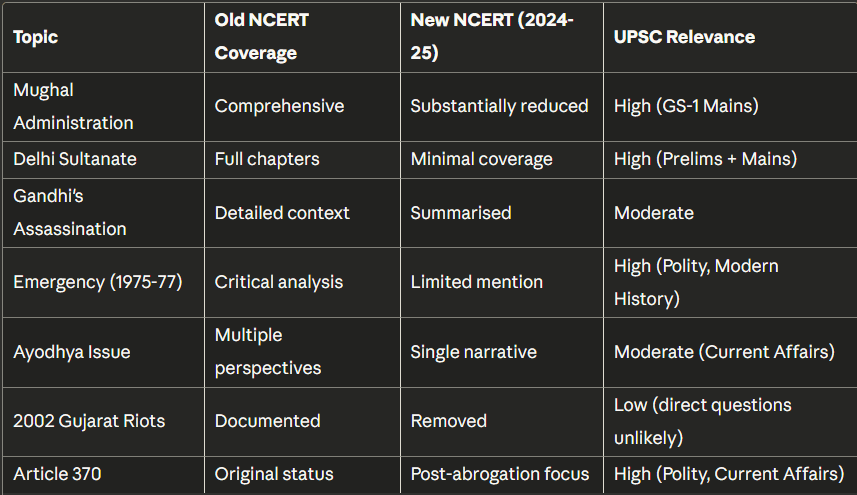
Which NCERTs to Follow?
Recommended Approach:
- Primary Reading: Use new NCERTs (2024-25) for baseline preparation—they align with current CBSE patterns
- Supplementary Reading: Consult old NCERTs for deleted topics that remain UPSC-relevant
- Critical Topics: For Mughals, Delhi Sultanate, and modern political history, old editions are non-negotiable
Handling Conflicting Information in UPSC Exams
The divergence between old and new NCERTs creates a unique challenge. Here's how to navigate it:
Strategy 1: Prioritise Factual Accuracy
UPSC values factual precision. When old and new NCERTs differ on facts, dates, or events:
- Cross-verify with standard reference books (Bipan Chandra, Spectrum, Laxmikanth)
- For historical facts, rely on academically established narratives
- For contemporary issues, supplement with newspapers and government sources
Strategy 2: Understand Multiple Perspectives
Mains answers benefit from balanced analysis:
- Acknowledge different interpretations where they exist
- Present evidence-based arguments rather than ideological positions
- Use phrases like "according to historical consensus" or "recent scholarship suggests"
Strategy 3: Current Affairs Integration
For topics like Article 370 or Ayodhya:
- New NCERTs provide the current government's perspective
- Supplement with Supreme Court judgments and constitutional analyses
- Frame answers around legal and constitutional dimensions rather than communal narratives
Strategy 4: Focus on Concepts Over Controversies
Examiners test understanding, not memorisation of controversies:
- Master the administrative, social, and economic aspects of any period
- Understand cause-effect relationships in historical developments
- Connect past events to contemporary relevance
Practical Preparation Framework
Phase 1: Foundation (Months 1-2)
- Complete new NCERTs (Classes 6-12) for all GS subjects
- Mark topics that seem truncated or incomplete
Phase 2: Gap Filling (Months 3-4)
- Read old NCERTs for marked topics
- Focus on R.S. Sharma (Ancient India), Bipan Chandra (Modern India)
- Use old Political Science NCERTs for Emergency and democratic movements
Phase 3: Integration (Ongoing)
- Create consolidated notes merging both versions
- Practice answer writing using balanced perspectives
- Solve previous year questions to identify UPSC's actual focus areas
Conclusion
The NCERT 2024 changes represent more than routine curriculum updates—they reflect evolving narratives in Indian education. For UPSC aspirants, the key lies not in choosing sides but in achieving comprehensive understanding.
Remember: UPSC tests knowledge, analytical ability, and balanced thinking. Use new NCERTs as your starting point, supplement with old editions for comprehensive coverage, and always prioritise factual accuracy over any particular narrative.
The civil services demand officers who understand India's complex past and present—prepare accordingly.
