Company Rule 1773-1858: Constitutional Evolution for UPSC Polity [PYQ Analysis]
11 min read
Jan 13, 2026
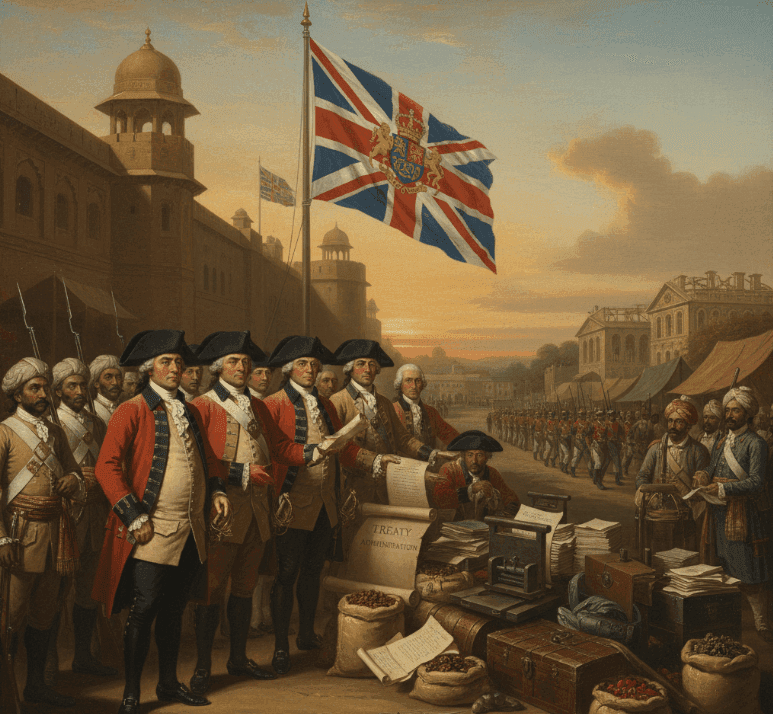
Every Act passed under Company Rule between 1773 and 1858 had two underlying objectives:
- Increasing control of the British Parliament over the East India Company’s rule in India – to ensure accountability and prevent corruption/mismanagement.
- Strengthening the centralisation of Company administration in India – by giving more power to the Governor-General and reducing the autonomy of Presidencies.
If you keep these two themes in mind, the logic behind every Act will become clearer and easier to remember.
For Prelims focus on key and major provision and facts , memorisation of all facts is not required. For mains focus on themes mentioned above.
📋 UPSC PYQ :
"The Charter Act of 1833 was important because:
1. It ended the commercial activities of the East India Company
2. It created the post of Governor-General of India
3. It opened civil services to Indians"
→ Answer: 1 and 2 only (Civil services opened in 1853, not 1833)
🧠 REMEMBER THE ACTS:
R-P-C-C (1773-1813-1833-1853)
"Regulation Paved Charter's Course"
Regulating Act (1773) - First British intervention
Pitt's India Act (1784) - Dual control established
Charter 1833 - Governor-General created
Charter 1853 - Civil services opened
TL;DR
✓ 8 Acts over 85 years (1773-1858)
✓ 3 Main Goals: Control Company, Centralize Power, Exclude Indians
✓ 2 Systems: Dual Control (1784-1858), Europeans-only (1793-1947)
✓ 1 Result: Modern bureaucracy with colonial exploitation
The Paradox: These acts created India's modern state structure while destroying its economy and society.
The Foundation of Modern Indian Governance
1. Introduction
1.1 Background and Context
The East India Company, initially established as a trading corporation in 1600, gradually transformed into a territorial power following the Battle of Plassey (1757) and the Battle of Buxar (1764). This transformation from merchant to ruler created an unprecedented situation—a private company governing vast territories and millions of people.

The British Parliament, recognizing the anomaly and potential dangers of unchecked corporate power, initiated a series of legislative interventions.
Two Primary Objectives Guided British Legislation:
- Control of British Parliament over the East India Company: Ensuring that a private company's actions align with British national interests and preventing autonomous decision-making that could embarrass or harm Britain's reputation.
- Centralization of Administration: Creating a unified administrative structure across British-controlled territories in India, moving away from the fragmented governance of multiple presidencies.
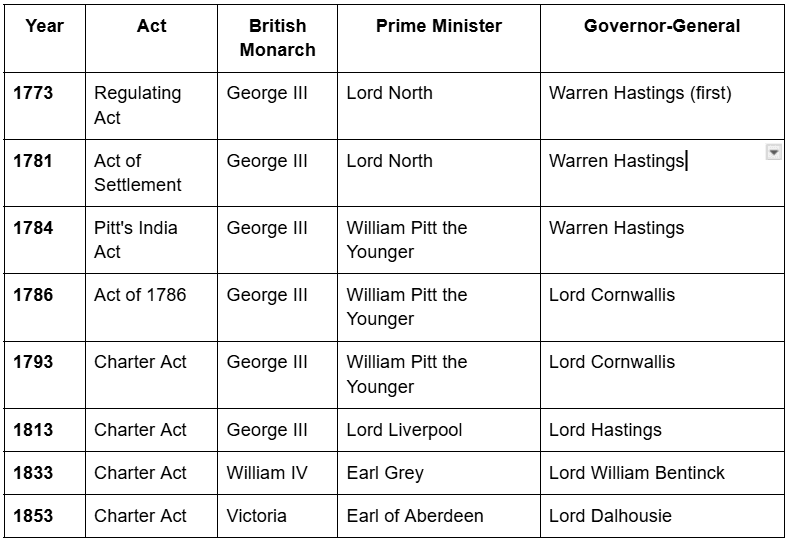
1.2 Timeline of Constitutional Acts
2. The Constitutional Acts: Detailed Analysis
2.1 The Regulating Act of 1773
Context
By 1772, the East India Company faced a severe financial crisis. The Company requested a loan of £1 million from the British government, providing Parliament with the perfect opportunity to assert control. Additionally, reports of corruption, misgovernance, and the Bengal Famine of 1770 (which killed millions) had created public outcry in Britain. The dual system of government in Bengal, where the Company collected revenue but the Nawab administered justice, had proven disastrous.
Key Provisions with Explanation & Rationale
1. Establishment of Governor-General of Bengal
- What: Created the position of Governor-General of Bengal with authority over Bombay and Madras presidencies
- Why: To ensure unified command and consistent policy across all British territories in India
- First Appointee: Warren Hastings
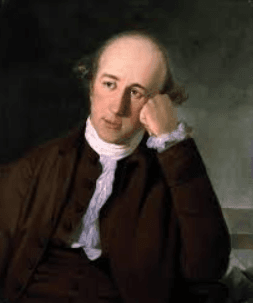
[Warren Hastings - 1st Governor General of Bengal]
2. Creation of Executive Council
- What: A four-member council to assist the Governor-General
- Why: To prevent autocratic rule and ensure collective decision-making
- Decision Process: Majority vote system, creating immediate conflicts
3. Establishment of Supreme Court at Calcutta (1774)
- What: First independent judiciary in India with British judges
- Why: To provide British-style justice and check administrative excesses
- Jurisdiction: Initially unclear, leading to conflicts with local courts
- Judges: Chief Justice and three puisne judges
4. Parliamentary Oversight
- What: Company required to submit revenue reports and correspondence to British government
- Why: To ensure transparency and accountability to Parliament
- Frequency: Regular dispatches on civil and military affairs
Other Provisions
- Term Limits: Governor-General and Council members appointed for 5 years
- Salary Regulations: Fixed salaries to reduce corruption (Governor-General: £25,000 per annum)
- Prohibition on Private Trade: Company servants banned from private trading and accepting gifts
- Court of Directors Reform: Election procedures modified to reduce corruption
Key Related Facts
- The Act led to the famous Warren Hastings Trial (1788-1795), though he was ultimately acquitted
- Created the "Judicial-Executive Conflict" between Supreme Court and Governor-General's Council
- The Council's majority often opposed Hastings, creating administrative paralysis (1774-1776)
2.2 The Act of Settlement, 1781
Context
The Regulating Act's ambiguous provisions regarding the Supreme Court's jurisdiction created chaos. The Court claimed authority over all inhabitants of Bengal, including Indian rulers and zamindars, leading to widespread resentment.
Key Provisions with Explanation & Rationale
1. Charter Extension
What: Extended Company's trade monopoly and territorial rights for 20 years
Why: Stability during European upheavals deemed essential
2. Separation of Revenue and Judiciary
What: Revenue administration separated from judicial functions
Why: To reduce corruption and ensure impartial justice
Implementation: Created distinct revenue and judicial hierarchies
3. Enhanced Salaries
What: Substantial salary increases for all senior positions
Why: To eliminate temptation for corruption and private trade
Other Provisions
Local Government Powers: Governors could override their Councils in emergencies
Trade Regulations: Stricter controls on private trade by Company servants
Missionary Restrictions: Christian missionaries still largely excluded
Board of Control Strengthened: Given power to pay expenses from Indian revenues
2.6 Charter Act of 1813
Context
By 1813, the Industrial Revolution had transformed Britain into the "workshop of the world." British manufacturers demanded access to Indian markets, while evangelicals pressed for permission to conduct missionary work. Napoleon's Continental System also influenced British commercial policy.
Key Provisions with Explanation & Rationale
1. End of Commercial Monopoly
- What: Abolished Company's monopoly except for tea trade and China trade
- Why: To satisfy British industrial interests and free trade advocates
- Impact: Opened Indian markets to British manufactured goods
2. Missionary Clause
- What: Permitted Christian missionaries to operate in India
- Why: Pressure from evangelical movement
- Regulation: Required licenses from Company but couldn't be unreasonably refused
3. Education Provision
- What: Allocated ₹1 lakh annually for education
- Why: To promote "learned natives" and Western knowledge
- Debate: Led to Orientalist-Anglicist controversy
4. Financial Accountability
- What: Enhanced parliamentary control over Indian revenues
- Why: To ensure proper utilization and prevent misappropriation
Other Provisions
- Local Governments: Empowered to impose taxes with Supreme Government approval
- Judicial Reforms: Provisions for appointing Indian judges in lower courts
- Trade Regulations: Detailed rules for British merchants in India
- Constitutional Status: First assertion that territory held "in trust" for the Crown
Key Related Facts
- Marked beginning of large-scale British capital investment in India.
- This led to a de-industrialization debate due to the influx of British manufactured goods.
- Foundation for Macaulay's Education Minute (1835)
- Created framework for modern missionary activities
2.7 Charter Act of 1833
Context
The Reform Act of 1832 in Britain brought liberal reformers to power. Influenced by Benthamite utilitarianism and free trade ideology, they sought comprehensive Indian administrative reform. The Act coincided with Lord William Bentinck's progressive governor-generalship.
Key Provisions with Explanation & Rationale
- End of Commercial Activities
What: Company ceased to be a commercial entity entirely
Why: To transform it into purely administrative body
Compensation: Shareholders guaranteed dividend from Indian revenues - Governor-General of India
What: Governor-General of Bengal became Governor-General of India
Why: To reflect authority over entire British India
First Holder: Lord William Bentinck
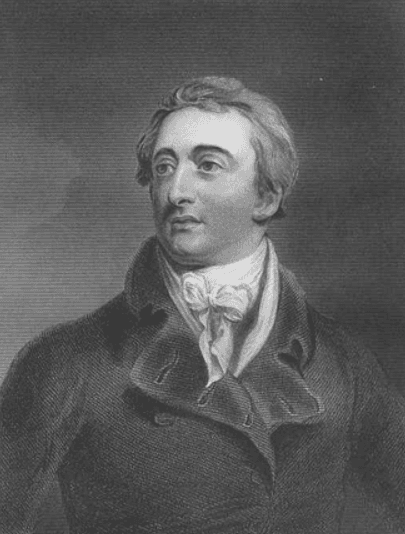
Lord William Henry Cavendish-Bentinck
3. Centralization of Legislation
What: Only Governor-General in Council could legislate for all India
Why: To ensure uniform laws across territories
Power: Could repeal or amend any law
4. Fourth Member (Law Member)
What: Added Law Member to Governor-General's Council
Why: To professionalize law-making
First Appointee: Lord Macaulay
Limitation: Could only participate in legislative proceedings
5. Equality Clause (Section 87)
What: No Indian subject disqualified from office due to religion, birth, descent, or color
Why: Liberal principle of merit-based appointment
Reality: Remained largely theoretical due to various barriers
Other Provisions
- Indian Law Commission: Established to codify laws
- Slavery Abolition: Provisions to end slavery in India
- Financial Controls: Strict budgetary procedures introduced
- Civil Service: Competitive examination principle accepted (implemented 1853)
Key Related Facts
- Led to codification of Indian laws (IPC, CrPC, CPC)
- Beginning of All-India legislation
- Created controversy over "Black Act" (1836) for European jurisdiction
- Marked shift from Oriental despotism to Liberal imperialism
2.8 Charter Act of 1833
Context
The last charter renewal occurred during a period of aggressive expansion under Lord Dalhousie. The Doctrine of Lapse, railway construction, and telegraph introduction marked this era. Growing criticism of Company rule and demands for Indian participation in governance influenced the Act.
Key Provisions with Explanation & Rationale
1. Separation of Legislative and Executive Functions
- What: Created distinct legislative wing in Governor-General's Council
- Why: To professionalize law-making and allow broader participation
- Size: Expanded to 12 members (6 additional legislative members)
2. Legislative Council Features
- What: Introduced parliamentary-style procedures
Questions and answers
Public proceedings
Published debates - Why: To bring transparency and accountability
- Significance: First step toward parliamentary system
3. Open Competition for Civil Service
- What: Recruitment through competitive examination
- Why: To ensure merit-based selection
- Implementation: First exam held in 1855 in London
- Age Limit: 18-23 years, favoring British candidates
4. Local Representation
- What: Four members from provincial governments in Legislative Council
- Why: To ensure regional perspectives in central legislation
- Representation: Bengal, Madras, Bombay, and North-Western Provinces
5. Charter Tenure
- What: No fixed period for charter renewal
- Why: Recognition that Company rule might be temporary
- Significance: Prepared ground for Crown takeover
Other Provisions
- Director Reduction: Board of Directors reduced from 24 to 18
- Judicial Reforms: Separate Sadar courts for Bengal
- Railway Guarantee: System for private railway investment
- Telegraph Authority: Powers for telegraph expansion
Key Related Facts
- Last Charter Act before 1857 Revolt
- Macaulay Committee recommendations implemented
- Satyendra Nath Tagore became the first Indian ICS officer in 1863
- Very few Indians could clear the exam in early years due to it being held only in London
- Created framework used by Government of India Act 1858
3. Overview of the Acts and Their Collective Impact
3.1 Administrative Evolution
The eight major acts from 1773 to 1853 transformed Indian administration from a hodgepodge of trading post governments into a sophisticated bureaucratic state. This evolution proceeded through distinct phases:
Phase 1 (1773-1784): Establishing Control
- Parliamentary oversight introduced
- Judicial system established
- Initial centralization attempts
Phase 2 (1784-1813): Consolidating Power
- Dual government system perfected
- Governor-General's authority strengthened
- Revenue and judicial systems separated
Phase 3 (1813-1833): Liberal Reforms
- Commercial monopoly ended
- Educational and social initiatives begun
- Legal codification initiated
Phase 4 (1833-1858): Bureaucratic State
- Pure administrative focus
- Legislative procedures developed
- Merit-based recruitment introduced
3.2 Long-term Constitutional Impact
Positive Contributions:
- Rule of Law: Established legal frameworks that persisted post-independence
- Administrative Unity: Created unified administration across diverse regions
- Modern Bureaucracy: Developed professional civil service traditions
- Legislative Procedures: Introduced parliamentary practices adopted by independent India
- Judicial System: Created court hierarchies still fundamental to Indian judiciary
Negative Legacies:
- Centralization Excess: Over-centralized structure unsuited to Indian diversity
- Racial Discrimination: Despite equality provisions, systematic exclusion of Indians
- Economic Drain: Financial structures facilitating wealth transfer to Britain
- Cultural Disruption: Missionary activities and Western education created cultural tensions
- Authoritarian Tendencies: Governor-General's vast powers set precedent for executive dominance
3.3 Seeds of Modern India
These acts inadvertently sowed seeds of modern Indian nationalism:
3.4 Toward Crown Rule
The constitutional experiment of Company rule ultimately failed due to inherent contradictions:
- Private company couldn't legitimately rule public territories
- Commercial interests conflicted with governance responsibilities
- Racial prejudices undermined liberal reforms
- Economic exploitation generated increasing resentment
The 1857 Revolt exposed these contradictions catastrophically, leading to the Government of India Act 1858, which transferred power to the Crown, ending the unique experiment of corporate colonialism.
4. Quick Revision Table
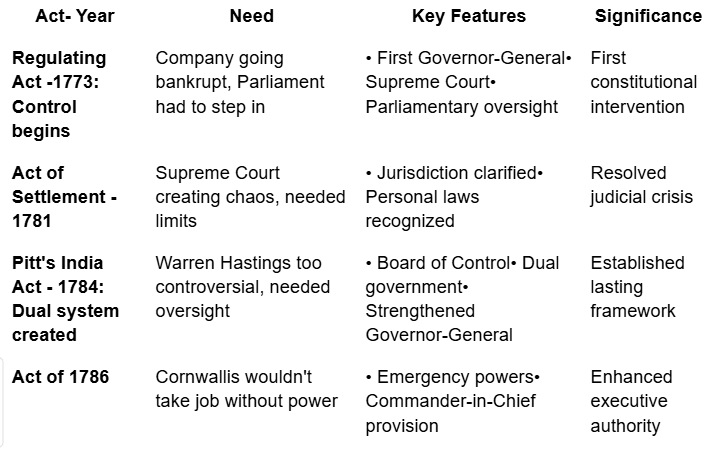
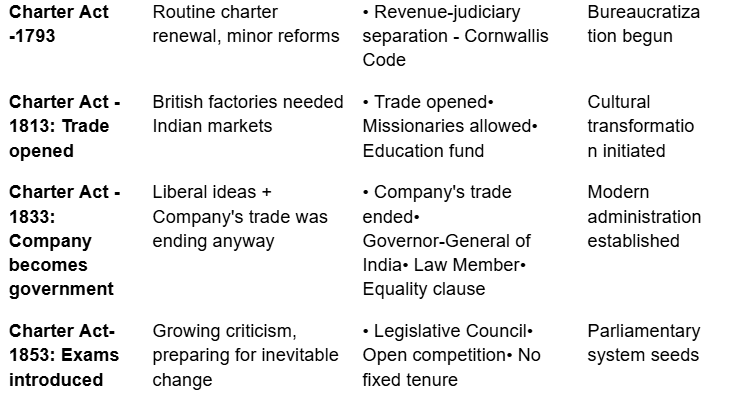
Major Constitutional Acts Summary
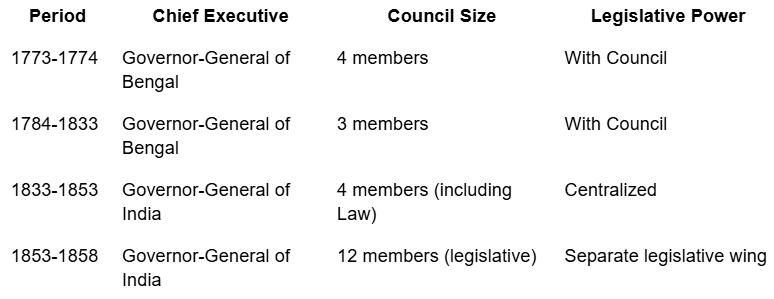
Evolution of Key Positions
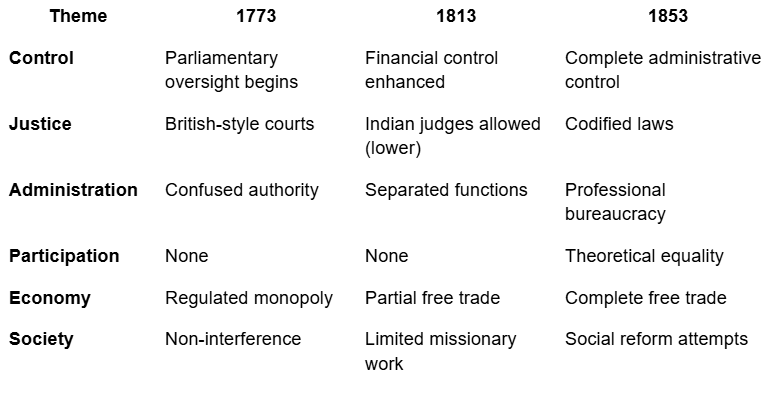
Constitutional Themes Evolution
Conclusion
Through eight major legislative acts, the British Parliament gradually transformed the East India Company from a commercial enterprise into a territorial government, establishing administrative, judicial, and legislative structures that would profoundly influence independent India's institutions.
While these acts were designed primarily to serve British imperial interests—controlling the Company, centralizing administration, and facilitating economic exploitation—they inadvertently created the institutional framework and political consciousness that would eventually challenge colonial rule itself.
For further reading( for your own interest and not for exam), consider exploring primary sources like Parliamentary Papers on East India Affairs, Warren Hastings' Trial Proceedings, and the writings of James Mill, Macaulay, and contemporary Indian observers like Raja Ram Mohan Roy and Dadabhai Naoroji.
