Inside the GRE 2025: Sections, Timing & Adaptive Scoring Explained
4 min read
Nov 27, 2025
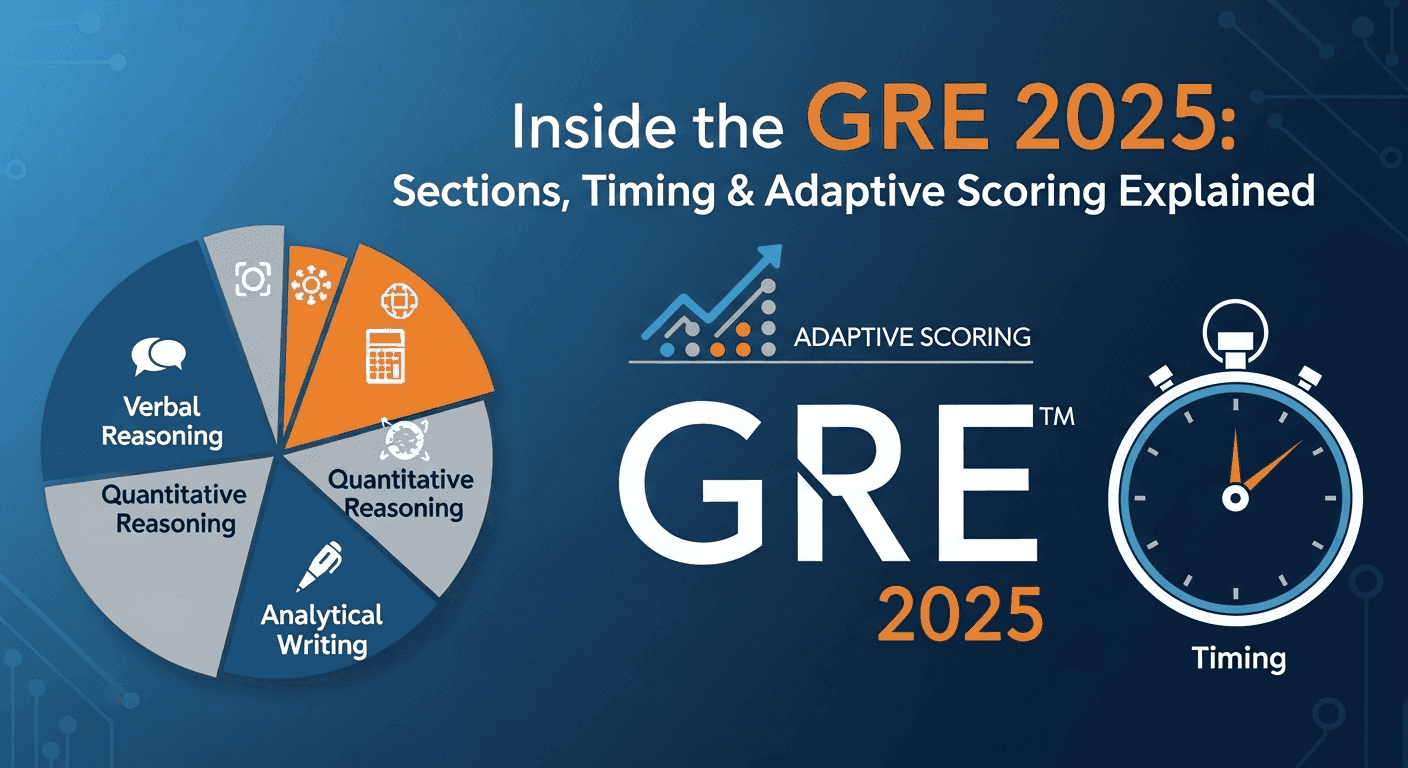
The GRE isn't just testing what you know—it's testing how well you understand the test itself. Before diving into vocabulary flashcards or algebra formulas, smart test-takers first decode the exam's structure. Here's your complete breakdown of the 2025 GRE format, with timing strategies and scoring insights that most prep guides overlook.
The GRE at a Glance: 5 Sections, Under 2 Hours
The current GRE runs approximately 1 hour and 58 minutes with 55 questions total. Here's the complete structure:
Analytical Writing (30 minutes): One "Analyze an Issue" essay always comes first. You'll take a position on a given statement and defend it with clear reasoning. This section is scored separately on a 0-6 scale.
Verbal Reasoning (41 minutes total): Split across two sections—Section 1 has 12 questions in 18 minutes, Section 2 has 15 questions in 23 minutes. You'll encounter reading comprehension, text completion, and sentence equivalence questions testing vocabulary and critical analysis.
Quantitative Reasoning (47 minutes total): Also two sections—Section 1 has 12 questions in 21 minutes, Section 2 has 15 questions in 26 minutes. Expect quantitative comparison, multiple choice, numeric entry, and data interpretation questions covering high-school-level math.
The Analytical Writing section is fixed at the start, but Verbal and Quant sections appear in random order afterward. There are no breaks between sections—when one ends, the next begins immediately.
Time Per Question: The Numbers That Matter
Understanding your time budget changes everything about pacing strategy.
For Verbal Reasoning, you have roughly 90 seconds per question in Section 1 and 92 seconds in Section 2. That sounds manageable until you hit a dense reading passage with four attached questions. The solution? Budget around 60-75 seconds for vocabulary questions (text completion and sentence equivalence) to bank extra time for reading comprehension.
For Quantitative Reasoning, Section 1 gives you about 105 seconds per question, while Section 2 offers approximately 104 seconds each. Data interpretation sets—where three questions share one graph or chart—require strategic time allocation. Spend the upfront time understanding the data, then move quickly through the questions.
The key insight: your first section in each subject contains fewer questions with proportionally less time per question. This means the margin for getting stuck is thinner when it matters most.
Section-Level Adaptive Scoring: How It Actually Works
Here's where the GRE gets strategic. Both Verbal and Quant use section-level adaptive testing, which means your performance on Section 1 directly determines the difficulty of Section 2.
The mechanics: Section 1 is always medium difficulty. Perform well, and Section 2 becomes harder. Struggle, and Section 2 gets easier.
Why does this matter for your score? The difficulty level of your second section sets your scoring ceiling. A test-taker who earns a harder second section and performs reasonably well will outscore someone who aced an easier second section. The algorithm rewards those who prove they can handle tougher material.
This creates a crucial strategic implication: Section 1 carries disproportionate weight. Getting 10 out of 12 questions right in Section 1 doesn't just give you points—it unlocks access to a higher-scoring path. Careless mistakes early can cap your potential score before you even reach the second section.
What "Doing Well" Actually Means
ETS doesn't publish exact thresholds, but test-takers and prep experts have reverse-engineered some patterns. Generally, answering 8-10 questions correctly in Verbal Section 1 or Quant Section 1 tends to trigger the harder second section.
However, trying to guess your performance mid-test is counterproductive. You cannot tell whether you received a hard or easy second section just by looking at the questions—difficulty is subtle, not obvious. A text completion with obscure vocabulary might appear in either version.
The practical advice: treat every question as if your scoring ceiling depends on it, because in Section 1, it does.
The Scoring Scale Explained
Both Verbal and Quantitative scores range from 130-170 in one-point increments. The adaptive mechanism determines where on this scale you can land.
Think of it this way: an easier second section caps your maximum around the mid-150s regardless of performance. A harder second section opens the path to 160+ scores. This is why two test-takers with identical raw correct answers can receive different scores—the difficulty path they took matters.
Your Analytical Writing score (0-6 in half-point increments) is evaluated separately by human graders and an automated scoring system. This score doesn't affect your Verbal or Quant numbers.
Strategic Takeaways for Test Day
Prioritize accuracy in Section 1. Speed matters less than correctness when the stakes include your scoring ceiling. If you need an extra 30 seconds on a tricky question, take it.
Use the review feature wisely. The GRE lets you mark questions and return to them within each section. Flag genuinely uncertain answers rather than questions where you're second-guessing yourself. Return only if you have solid time remaining.
Don't analyze difficulty mid-test. Wondering whether you got the hard or easy version wastes mental energy and creates anxiety. Stay focused on the question in front of you.
Practice under realistic conditions. The no-break format and immediate section transitions create fatigue. Your practice tests should simulate this exactly—no pausing between sections, no phone checks, no bathroom breaks.
The Bottom Line
The 2025 GRE rewards test-takers who understand its structure as deeply as its content. The adaptive scoring system means your strategic approach in Section 1 shapes your entire score potential. Master the timing, respect the mechanics, and you'll walk into test day with the confidence that comes from truly knowing what you're facing.
