UPSC Prelims Economy Strategy (2015–2025) with PYQ Insights
7 min read
Dec 01, 2025
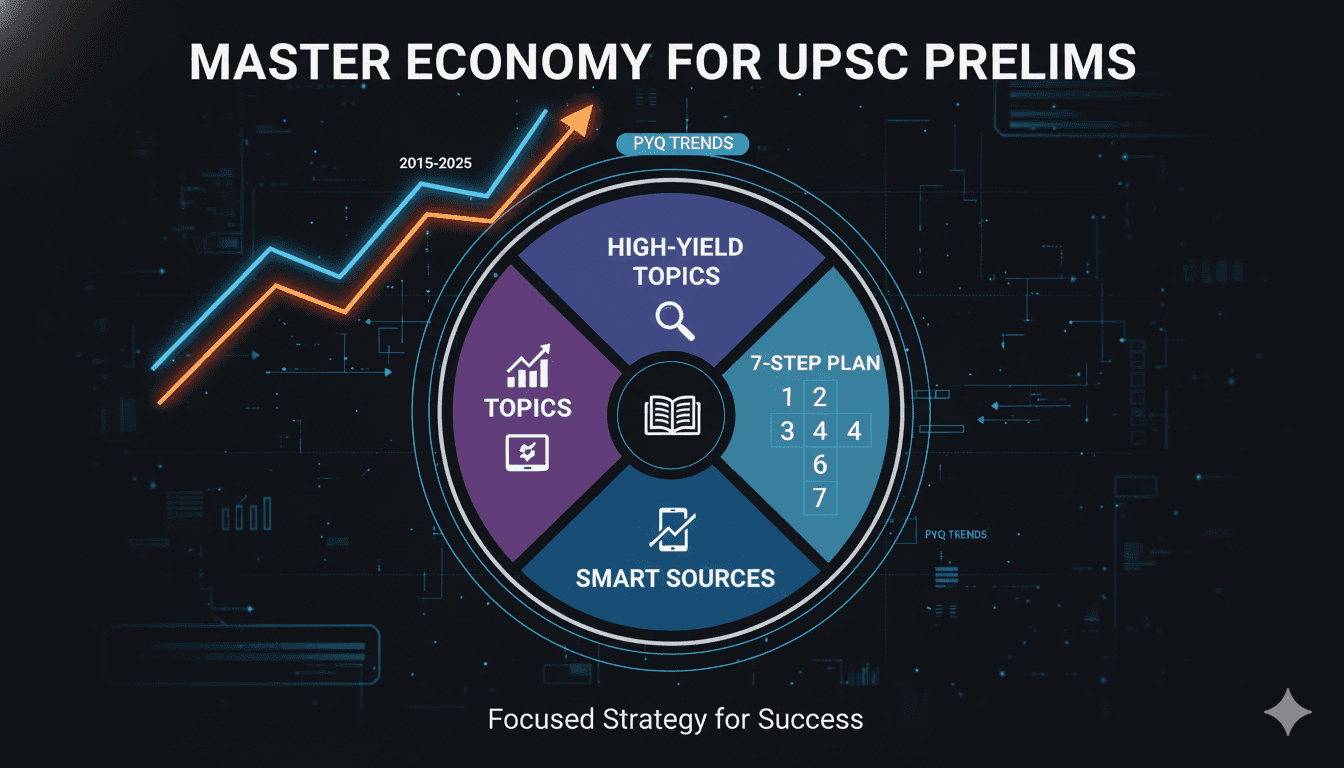
UPSC Economy Strategy 2026: Complete PYQ Analysis (2015-2025) with Topic-wise Breakdown
The Indian Economy isn't just a subject in the vast UPSC syllabus; it's a cornerstone of the Prelims paper. This guide provides a clear UPSC Prelims Economy strategy based on a detailed UPSC Economics PYQ analysis of all papers from 2015 to 2025. Instead of generic advice, we'll show you exactly how to study Economy for UPSC by focusing on what truly matters.
This is your ultimate roadmap to crafting a powerful UPSC Economy preparation plan.
UPSC Economy Prelims PYQ Analysis: Is the Indian Economy High-Scoring?
Before diving into topics, let's understand the battlefield. The data clearly shows why you can't ignore this subject.
- Heavy Weightage: An average of 16-18 questions have appeared from Economics each year for the last decade. This is a potential of 32-36 marks that can decide whether you clear the cutoff.
- Balanced Difficulty: Our analysis shows a favorable difficulty split: roughly 40% of questions are easy, 35% are medium, and only 25% are difficult.
- Highly Scoring: Strong conceptual clarity is rewarded more than rote learning. A solid foundation helps you logically solve even unfamiliar questions, making this a high-scoring area.
- Static- Current Divide : Mostly the Static questions are conceptual in nature like testing the difference between money and capital market. The current affairs questions are generally factual in nature like trade trends of India.
Economy Important Topics for UPSC Prelims: The High-Yield Areas
Our UPSC Prelims Economy 10-year PYQ analysis reveals a staggering pattern: over 60% of questions are rooted in Macroeconomics. Your preparation must be laser-focused here.
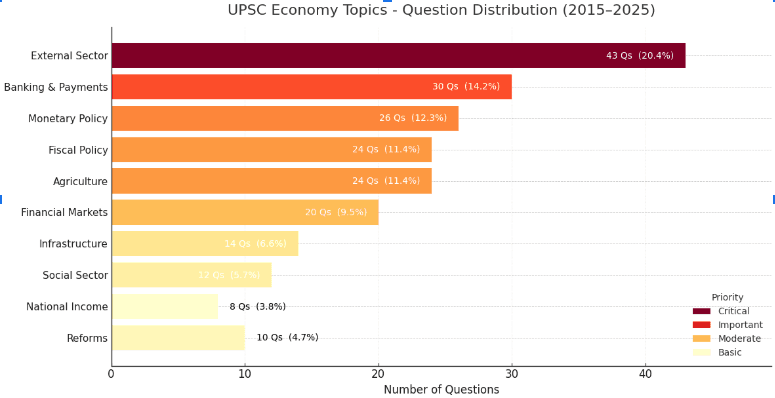
Based on 10 years of actual questions (not predictions), here's your focus roadmap:
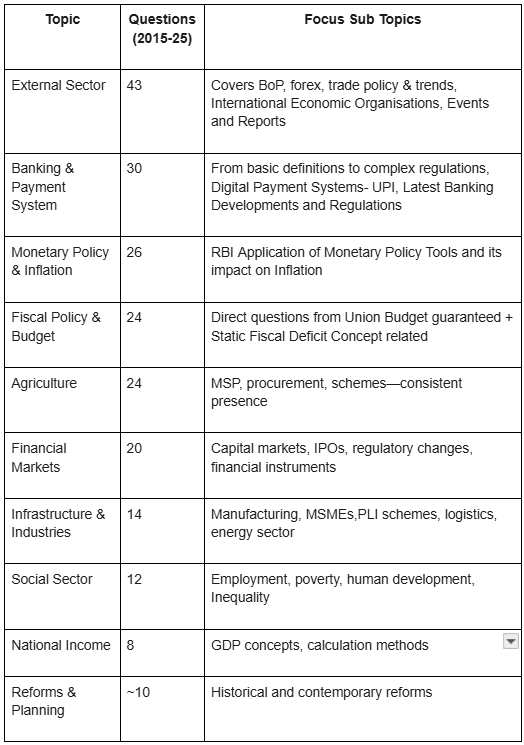
The Golden 5 Topics (Over 70% of Questions!)
Forget trying to cover the entire ocean. Focus on the high-yield fishing spots. Your entire preparation for UPSC Economics should revolve around these five pillars. Master them, and you've won half the battle
- External Sector (~43 Questions)
- Banking & Payment Systems (~30 Questions)
- Fiscal Policy & Government Budgeting (~24 Questions)
- Monetary Policy & Inflation (~24 Questions)
- Agriculture (~23 Questions)
Decoding UPSC's Question Psychology: How They Test Economics
Three Distinct Testing Patterns
Our analysis reveals UPSC uses mainly three specific approaches to test economic understanding:
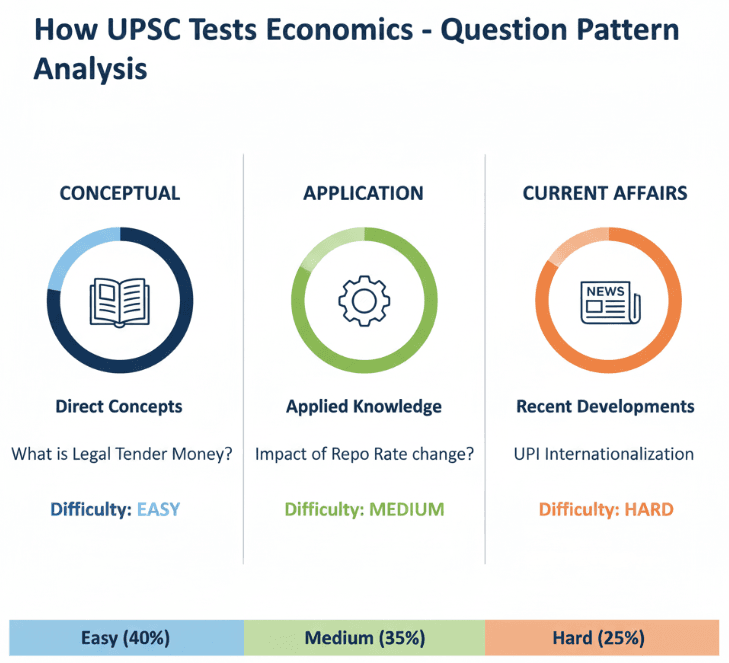
Pattern 1: Pure Conceptual Testing (40% of questions) These test whether you understand fundamental concepts clearly.
Example from 2023: "What is 'Legal Tender Money'?"
- Tests: Basic definition
- Source: NCERT/Standard textbook
- Difficulty: Easy if concepts are clear
Pattern 2: Application Scenarios (35% of questions) These require applying static knowledge to dynamic situations.
Example from 2022: "If RBI reduces Repo Rate, which of the following is likely to happen?"
- Tests: Understanding of monetary transmission
- Source: Conceptual understanding + current context
- Difficulty: Medium, requires logical thinking
Pattern 3: Current Affairs Integration (25% of questions) These blend recent developments with theoretical frameworks.
Example from 2024: Questions on digital currency, UPI internationalization
- Tests: Awareness + conceptual clarity
- Source: Newspapers + Economic Survey + RBI reports
- Difficulty: Challenging without regular reading and sometimes random questions
Indian Economy Book List UPSC & The Best Sources
A minimalist and focused approach works best. Here's a curated list.
- Foundation (The Bedrock):
NCERT Class 9th and 10th
NCERT Class 11: Indian Economic Development
NCERT Class 12: Introductory Macroeconomics
- Advanced Understanding (Pick ONE):
Indian Economy by Ramesh Singh
Indian Economy by Nitin Singhania
Indian Economy by Gaurav Aggrawal
Indian Economy by Vivek Singh
Choose any one standard book and use it selectively to fill conceptual gaps and do not read cover to cover. - Current Affairs (The Deal Clincher):
The latest Union Budget & Economic Survey.
A quality newspaper (The Hindu or The Indian Express) for the best sources for Economy current affairs UPSC.
Reference Websites: RBI (for monetary policy), Investopedia.
The Game Plan: A 7-Step Action Plan for Your UPSC Economy Preparation
- Integrate Sources: Start with NCERTs to build a rock-solid conceptual base. Use a standard reference book to fill gaps and add depth. Don't read reference books cover-to-cover; use the syllabus and PYQs to guide your reading.
- Master the Core: Give maximum time to high-yield areas. Your primary focus should be on Banking, Monetary Policy, Fiscal Policy, External Sector, and Agriculture. Master all the key concepts and their application like CRR, SLR, Repo, Fiscal Deficit, BoP, and MSP.
- Understanding Over Memorization: Economics rewards logical thinking. If you understand why repo rate affects inflation, you can answer five different question variations.
- Smart Note-Making: For conceptual topics or portions (e.g., inflation, monetary policy, external sector etc.), create mind maps or flowcharts. For factual topics (e.g., schemes, , indices, reports etc.), create one-page summaries with key objectives and features for quick revision and memorisation.
- Link Static and Dynamic: Use the newspaper as a trigger. If you read about the Monetary Policy Committee (MPC) raising the repo rate, revise the entire static concept of monetary policy tools. This active linkage is the key to mastering Economics for UPSC.
- Revision Strategy: Revise the subject at least 3-4 times. Economics is highly conceptual, and multiple revisions are needed to internalize the links between different topics.
- Mock Tests: Practice is crucial. Take at least 7-8 mock tests and analyze your performance, especially on application-based questions. Supplement your preparation by taking regular mock tests to build confidence and improve time management
Turn Strategy into Score
Knowing the strategy is the first step. Executing it makes the difference.
Ready to put this blueprint into action? The best way to master these concepts and test your application skills is through consistent, targeted practice.
Download the PrepAiro app now! Access our daily Economy current affairs quiz, practice thousands of questions from high-yield topics, and use our Economy revision checklist to stay on track.
Stop studying hard. Start studying smart.
Frequently Asked Questions (FAQs)
Q1: What are the 5 most asked Economy topics in UPSC Prelims?
Based on our 10-year analysis, the top 5 topics are the External Sector, Banking System, Fiscal Policy, Monetary Policy & Inflation, and Agriculture. Together, they account for over 70% of the questions.
Q2: How to cover Economic Survey for UPSC quickly?
Don't read it cover-to-cover. Focus on the summary of each chapter, key terms defined in boxes, and the overall theme. Reading a good summary document or our Economic Survey one-page notes can help you finish it in 5-7 days.
Q3: How to link current affairs with Economy static for UPSC?
Use the newspaper as a trigger. If you read about a change in repo rate, revise monetary policy. If there's news about India's trade deficit, revisit your Balance of Payments notes. This active linkage is the key.
Q4: Is Indian Economy a high weightage subject in UPSC Prelims?
Yes, absolutely. With an average of 16-18 questions per year, it is one of the most important subjects for clearing the Prelims cutoff.
